
Optimize Profile
In many cases, it is sufficient to work with the paper profiles generated with calibration. In cases of particularly high demands on the color consistency, you can optimize profiles for specific paper types iteratively, i.e. you use an existing profile to print a profile test chart again directly via the workflow with appropriate CMM settings. Then, you can directly measure the printed test chart in Prinect Color Toolbox and generate a corrected or optimized color profile there.
The paper profile resulting from this is more precise than the original profile. To further increase the precision, you can repeat this several times.
Optimize Profile with Integrated Colorimeter
Optimization as described above is not possible for printers with an integrated measuring device (unless an external measuring device is additionally available) because a test chart that is already printed cannot be loaded to the printer at a later time.
With the "Optimize Profile" module, you can iteratively optimize profiles using a measuring device integrated in the printer.
To optimize a profile, proceed as follows:
•First, load a test chart file, a calibration file (.epl file) referring to an ICC profile, and a reference ICC profile file to the user interface. The calibration file and the profile file were generated in the "Create Calibration" and "Connect Profiles" program steps.
•Then start the profile iteration process. To do so, print the test chart on the printer while applying the calibration and the reference profile and then have it measured automatically with the integrated measuring device.
•Color Proof Pro generates an IT8 file from the measured data that will be used internally for generating an optimized ICC profile.
Prerequisite: This type of profile optimization only works for proofers with a built-in colorimeter. In addition, the printer used must be fully set up in "Color Prof Pro Settings" (see Setting Up Printers and Installing Profiles).

1.Start the "Optimize Profile" module.
The "Select a printer" dialog opens:

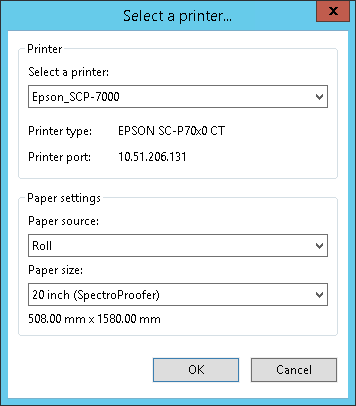
2.Select the printer whose profile you want to optimize. The list shows only those printers that feature an integrated measuring device. The printer must be connected and ready for operation.
If applicable, specify the paper source and size.
3.Confirm the dialog with "OK". The window where you can set up the test chart output displays.

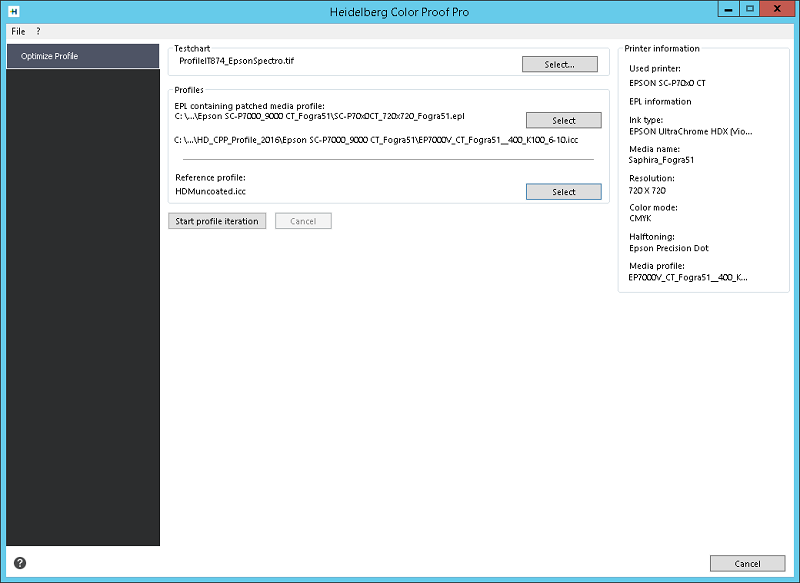
4.In "Testchart", select a test chart to print for optimization.

Note: Normally, you must always select a CMYK test chart here, even if you want to optimize a Multicolor profile.
Multicolor press profiles (CMYKOGV) are generally used for proofing on a Labelfire inkjet machine. If a proof simulation is to run for such a Multicolor color space, the proof profiles used for these Multicolor profiles must be optimized with the Prinect Color Toolbox to obtain good results. In this case, you should select a CMYKOGV test chart that you can then use in Prinect Color Toolbox for optimization.
5.In "Profiles", select the calibration file (.epl file) linked to the ICC profile to optimize (see Connect Profiles). If an ICC profile was generated with Color Proof Pro (without using the Prinect Color Toolbox), open the folder that contains the .EPL file and the .ICC file of the desired profile. Select the .EPL file here. See Create Automatic Mode and ICC Profiles in Color Proof Pro.
6.In "Reference profile", select the ICC profile file to be used as reference profile.
7.Start printing with "Print chart". Printing and measuring can take longer (up to 30 minutes!). After the chart was successfully printed and measured, a message displays:

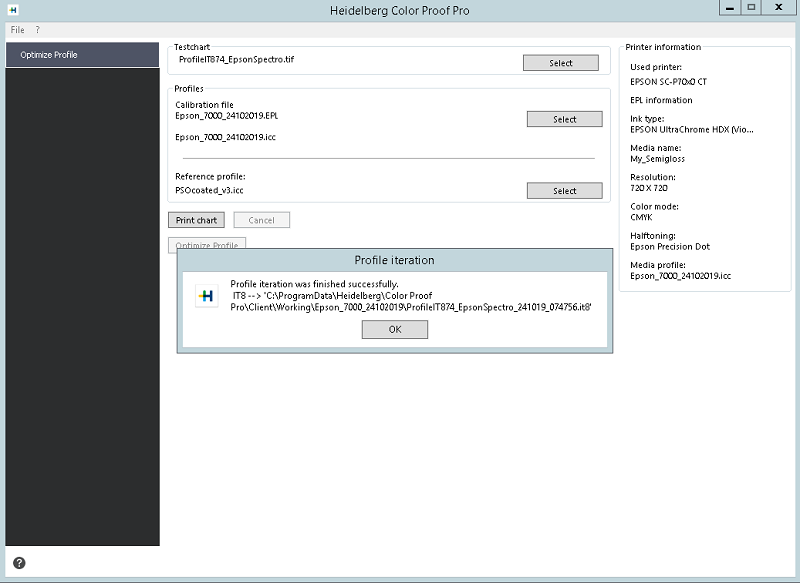
The measurement result is filed as an IT8 file in a subfolder of the "Working" folder (C:\Program Data\Heidelberg\Color Proof Pro\Client\Working).
8.Click "Optimize Profile". Select the location for the optimized profile:

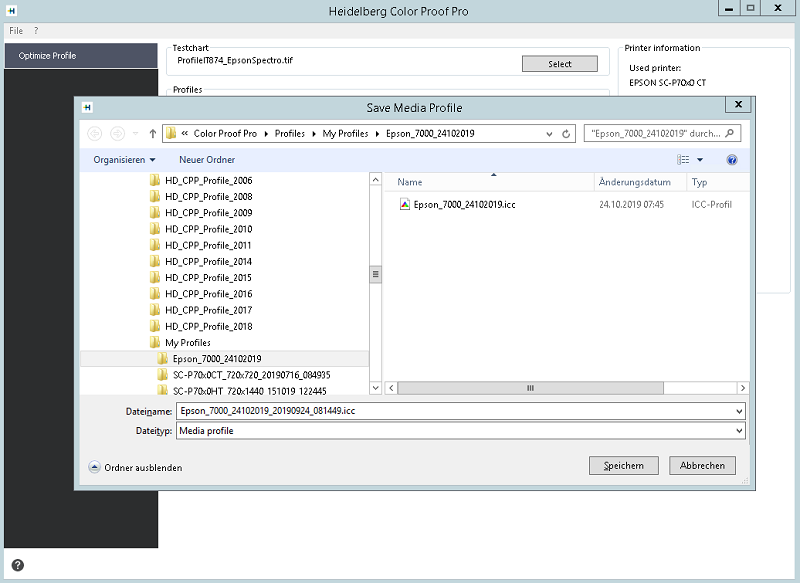
Based on the measurements, the existing ICC profile is optimized with the internal algorithms.
When optimization is finished, a message appears:

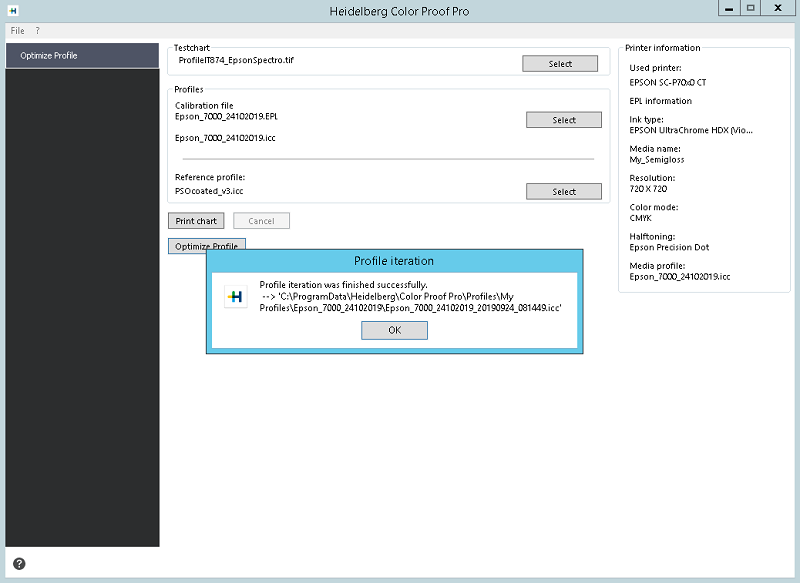
(9).As an alternative, you can use this IT8 file as a basis to generate the ICC profile externally in the Prinect Color Toolbox. This is only necessary if you need special color settings that are only available in the Prinect Color Toolbox.